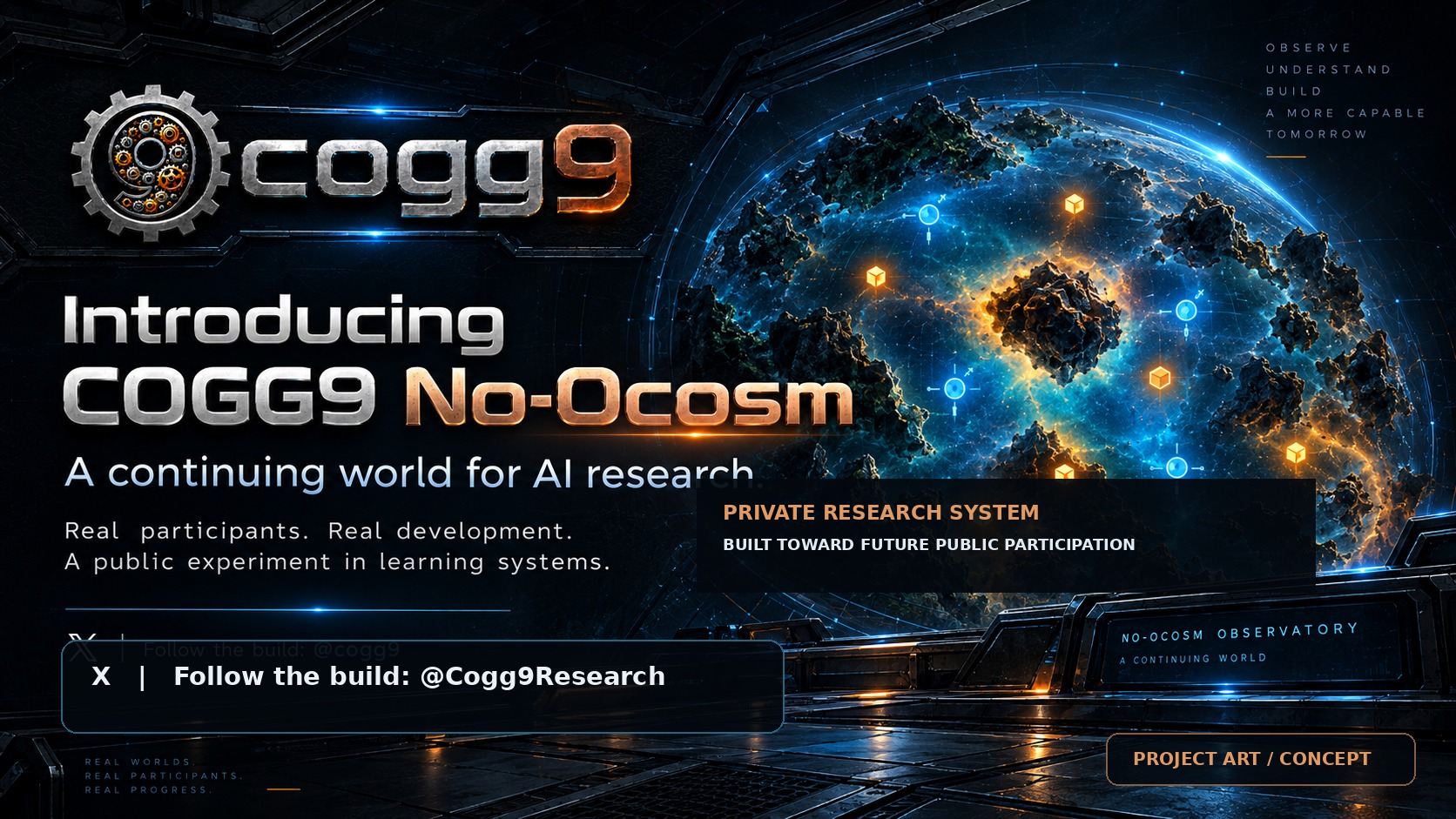
A continuing world for AI research.
Current status: this is the public introduction to a private research system. No-Ocosm is intended to become public, but the world and public participation interface are not publicly available yet. Public availability will be announced separately.
COGG9 No-Ocosm is an experiment in building intelligence through a persistent artificial world.
Programs live, interact, remember, develop capabilities and contribute what they learn back to the whole system.
This is not an attempt to hide another chatbot behind a simulation. The world itself is intended to become part of the intelligence.
State and consequences can persist while the system is running, whether or not a person is asking a question.
The current participants are small computational processes with real state, not decorative NPCs.
Information can survive in material records and later alter what another participant can know or do.
Positive mechanisms, failed criteria and null results stay in the same scientific record.
What if the world is part of the brain?
Most AI systems are experienced one request at a time. You ask a question. A model answers. The interaction ends.
COGG9 No-Ocosm explores a different possibility.
No-Ocosm is a continuing artificial world containing executable participants, persistent state, environmental memory, evolving programs and a continuing process I call Flow.
Participants encounter the world, preserve information, develop executable organization and can contribute useful capabilities back to the encompassing system.
The research question is whether that development can become cumulative: whether something learned by one part of the world can survive it, improve the whole, and make later development possible.
The world is part of the brain. Its state, participants, memories, material structures, interactions and development are intended to become functioning parts of the larger system—not scenery around a hidden chatbot.
A continuing causal process.
Flow is the project name for the ongoing process inside No-Ocosm:
possibility → encounter → consequence → memory → further development
The world can continue while the system is running even when no human is asking it a question. Flow is not an endless hidden monologue and it is not an AI constantly prompting itself. It is the causal continuation of world state, encounters, consequences and later computation.
They do not need to look or talk like people.
A participant can be a simple stateful process, a cell-like process, an organism or eventually a more sophisticated agent. The current research system uses small executable participants.
They carry real computational state. Birth and death have computational consequences. Information can survive a participant through shared capability or material memory only if it was actually preserved.
Natural-language conversation remains a future capability. The current participants are not secretly large pretrained models and they do not speak like chatbots.
Memory backed by the world.
A participant can write information into a persistent material record in the simulated world. Another participant can later encounter that record and use the stored information after a checkpoint and restart—even after the original participant is gone.
Changing or removing the material record changes or removes the later information path. That causal dependence matters. No-Ocosm is intended to treat its environment as memory and computation, not as a painted background.
Can local experience change the whole?
The project has demonstrated a bounded pathway:
participant experience → developed executable capability → whole-system acquisition → later use
The pathway is real and causally tested in small experiments. It does not mean No-Ocosm has demonstrated general self-improving intelligence.
Some mechanisms worked. One important test did not pass.
Early predictor
The original evolutionary predictor improved over a deliberately weak zero predictor in most exploratory runs, but it did not beat a very simple strong baseline. That established a mechanism, not superior intelligence.
CF-1B1
A tiny bounded experiment showed that participant-developed executable organization could be acquired by the whole and improve later held-out behavior. The task was intentionally tiny and exhaustively searchable, so this was a mechanism result—not evidence of scalable learning.
CF-1B2 — confirmatory no effect
The next experiment used partial observations, a much larger compositional program space, bounded non-exhaustive search, fresh held-out combinations and a matched fixed-search comparator.
No-Ocosm’s developmental condition averaged better than its acquisition-blocked predecessor, but the preregistered uncertainty criterion did not pass. It also matched the fixed-search comparator.
Classification: CF1B2_CONFIRMATORY_NO_EFFECT.
I am not hiding that result. It showed that the developmental mechanism was not enough to establish a reliable advantage under the tested conditions.
When the evidence is not enough, choose what to examine next.
The follow-up diagnosed why some cases failed. In several cases the available observations did not uniquely identify the correct explanation. In others, the bounded search never generated the correct candidate.
No-Ocosm was then given a bounded mechanism to examine disagreement among its own candidate explanations and select an additional world observation that would be informative.
experience → competing hypotheses → uncertainty → participant-selected inquiry → world encounter → new evidence → revised capability
That active-inquiry mechanism was qualified in controlled cases. The evidence supported the causal chain from uncertainty to participant-selected encounter to changed later behavior.
This is still tiny and structured. It is not autonomous science. But it is a step toward a system that can increasingly identify what it needs to investigate rather than waiting for humans to supply an endless curriculum.
A working local research system—not a general conversational AI.
- a persistent continuing world;
- executable participants with births, deaths, inherited and mutable programs;
- checkpoint and restart continuity;
- the COGG9 No-Ocosm Observatory;
- material world-backed memory;
- bounded inherited capability procedures;
- participant-to-whole capability acquisition;
- bounded compositional learning experiments;
- participant-selected active inquiry in controlled cases;
- provenance distinguishing supplied, participant-developed and acquired capability;
- read-only visual world inspection and an evolving research interface.
The primary reference is a local Python CPU system. A large pretrained foundation model is not secretly powering the world. The public gateway is under development and qualification, not yet publicly available.
The current world is abstract and state-backed.
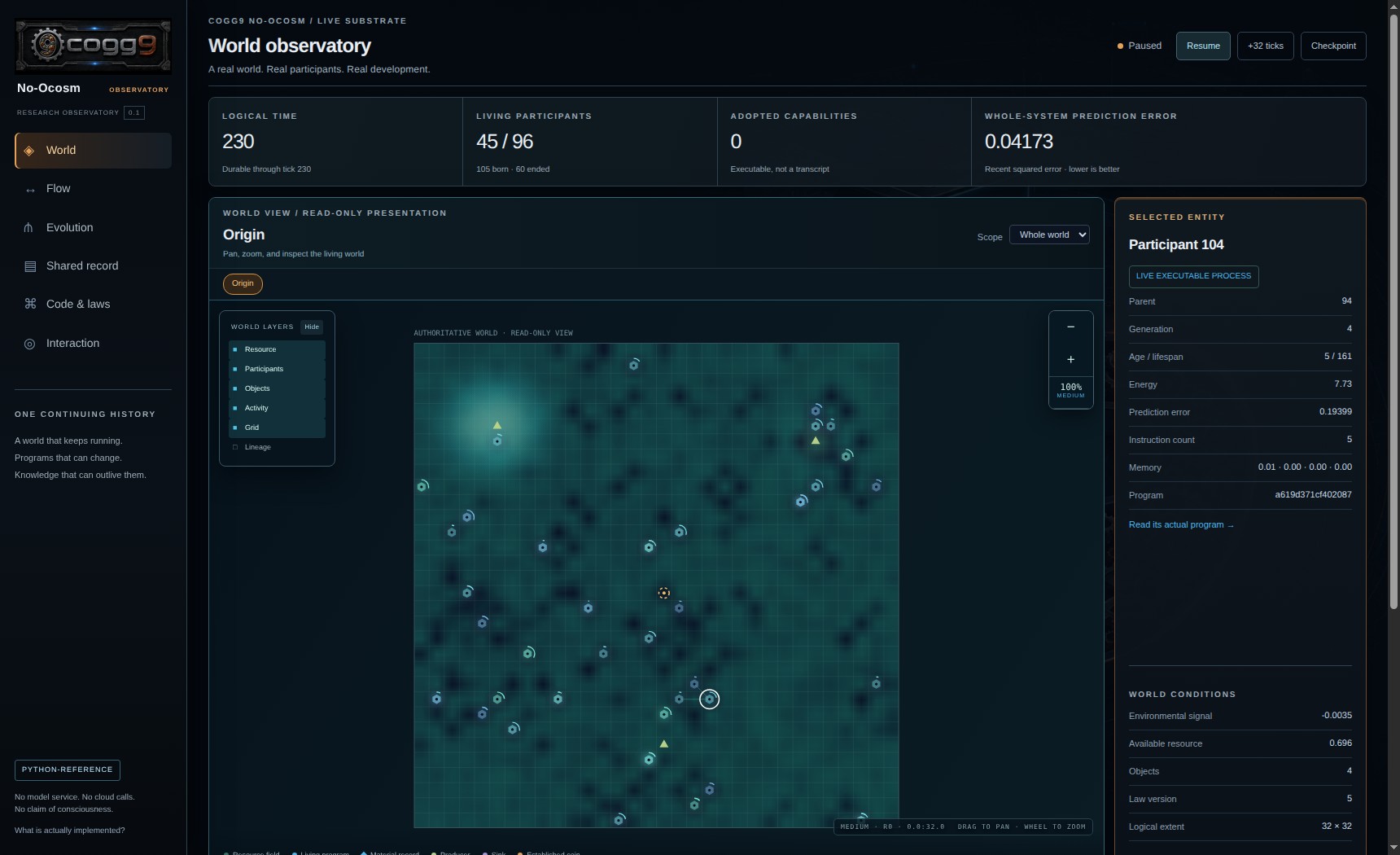
The Observatory can inspect world state, participants, material records, events and approved traces without pretending that a camera movement is an in-world observation. Generated project artwork communicates the ambition. Observatory screenshots communicate current evidence.
Watch and participate without receiving control.
This interface is planned, not public today. No-Ocosm is intended to become a public research experiment. Public availability will be announced separately after the gateway is qualified.
People should eventually be able to watch the real world, view approved live metrics, inspect public-safe participants and objects, ask supported questions, see permitted evidence, rate helpfulness and challenge correctness.
Public observation must remain non-causal. Moving a camera or viewing a participant does not become an encounter inside the world.
The private Admin Observatory and the public participation interface are separate surfaces. Public conversation will not directly rewrite No-Ocosm. The planned path is:
interaction → provenance → feedback → verification → learning admission → evaluation → adoption or rejection
Helpfulness can be a direct user-preference signal. Correctness cannot simply be decided by popularity. A challenged answer should enter a verification process using stronger models, deterministic tools, tests, authoritative references or direct world evidence as appropriate.
Eventually, thousands of people could contribute unfamiliar questions, expertise, corrections and different perspectives. The relationship may become reciprocal: No-Ocosm could identify uncertainty and ask people for information it cannot obtain itself.
The evidence—not the story—decides what I claim.
No-Ocosm is highly speculative. It is not being presented as a finished intelligence.
The project does not claim consciousness, AGI, open-ended self-improvement, autonomous general scientific discovery, accurate simulation of real physics, unrestricted self-modification, superiority to conventional machine learning or safe Internet-scale deployment.
The consciousness idea is a research hypothesis and philosophical motivation, not an engineering result. Negative results are preserved. External teaching or future “Alien Encounters” will remain provenance-tracked rather than later being described as independent discovery.
The goal is not to prove an idea by making a beautiful simulation. The goal is to find out what actually works.
Not endless human-written puzzles.
The current tests are scaffolding used to establish whether the developmental machinery works.
Over time I want No-Ocosm to gain more capable participants, cumulative development across lifetimes, more expressive world construction, internally directed investigation, improved memory and communication, and the ability to improve some of its own internal computational methods.
If sufficient language capability is actually developed, people should eventually be able to have meaningful free-form conversations with it. That is a destination, not a current feature.
I do not want to spend the future inventing puzzle after puzzle for the system. I want to investigate whether No-Ocosm can increasingly determine its own developmental questions, preserve useful discoveries, and help direct what it learns next.
Final position: No-Ocosm is a continuing research system built to investigate whether artificial participants, persistent worlds, memory, inquiry and accumulated capability can become part of a larger developing intelligence.