HASHNODE-256: Can Retired Bitcoin Miners Become AI Hardware?
Building AI backwards from SHA-256 silicon.
Instead of trying to force a conventional neural network onto a fixed-function Bitcoin-mining ASIC, HASHNODE-256 asks what kind of architecture would make that hardware useful by design.
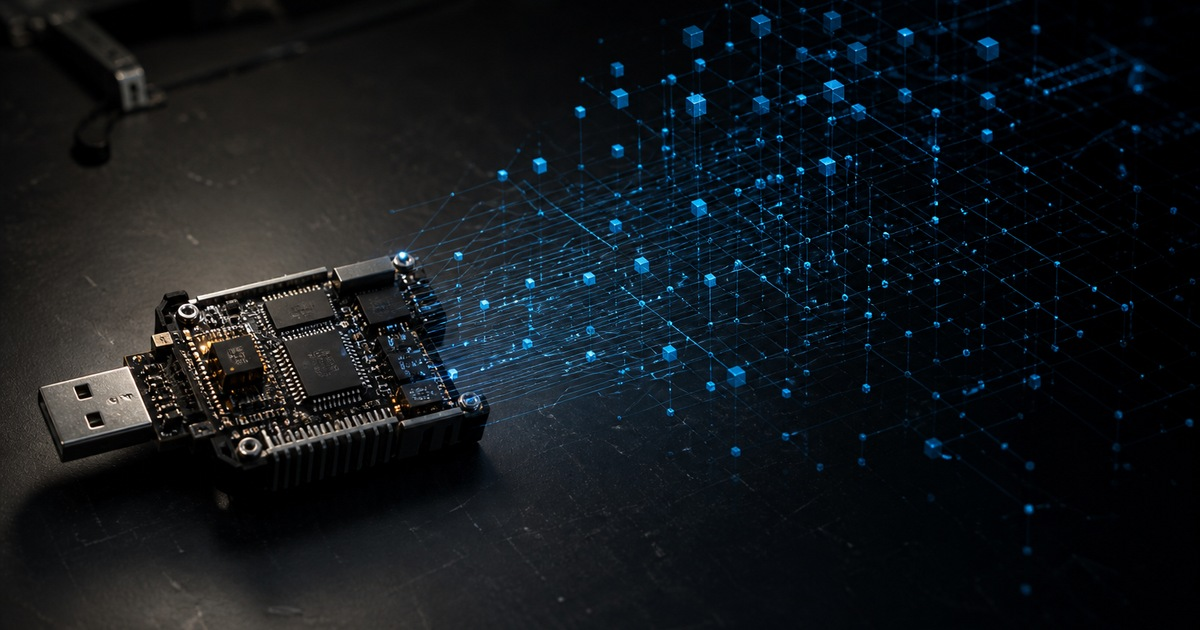
Design the computational object around what SHA-256 ASICs already do well instead of treating them as broken GPUs.
The provisional HASHNODE is a 256-bit binary state reconstructed from sparse nonce discoveries.
Hardware search comes first. Learned selection is a later gate and has not yet been tested.
Build the model for the miner—not the miner for the model.
The usual question is how to make unusual hardware run a familiar AI model. That is the wrong starting point here. Bitcoin-mining chips are specialized for massive SHA-256 nonce search. They are not flexible GPU replacements.
HASHNODE-256 starts from that limitation and treats it as the design constraint: what kind of learned system could make native SHA-256 search useful as its expensive computational step?
The goal is not to turn a miner into a GPU. The goal is to investigate an architecture built around the computation the miner already performs.
A provisional 256-bit native object
The project’s provisional object is a 256-bit HASHNODE: a binary state whose useful meaning may eventually emerge from relationships, learned selection, composition, persistent identity, state transitions, memory, and recursive structures.
A HASHNODE is not claimed to be equivalent to a biological neuron or a conventional neural-network neuron. Right now it is a research object: a complete 256-bit candidate state that can be reconstructed from the miner’s sparse returned nonces.
Put the expensive search on the ASIC
The intended division of labor is strict. The SHA-256 ASIC performs massive candidate search. The CPU or controller creates work, maintains state, receives sparse results, independently verifies returned candidates, and performs bounded selection.
If the research reaches later stages, the host may also handle memory and language interfaces. It must not quietly replace the miner by enumerating the nonce range itself.
The physical search boundary has been verified
Using a GekkoScience NewPac with a BM1387 device, the project verified a native hardware loop:
- deterministic controlled work reaches the miner;
- the BM1387 performs native nonce search;
- sparse nonce results return to the host;
- the host independently reconstructs the corresponding 256-bit SHA-256d result;
- the host does not enumerate the nonce range itself.
This proves the physical hardware/search boundary needed to continue. It does not prove intelligence or AI acceleration.
The next primitive is frozen
HASHNODE_SEARCH_V0(seed_256, epoch) -> sparse candidate_256 discoveries
The byte-frozen 0B design uses a caller-provided 256-bit seed and deterministic epoch to construct synthetic work. The SHA ASIC searches nonce space. Sparse returned nonces are then independently reconstructed into complete 256-bit candidate states.
The design is ready for one bounded NewPac implementation and physical execution. That execution is next; it is not being reported as complete.
Intelligence is an evidence gate, not a launch claim
The project advances only when evidence earns the next stage.
What HASHNODE-256 does not demonstrate today
HASHNODE-256 has not demonstrated intelligence, learned cognition, reasoning, language ability, useful AI acceleration, semantic HASHNODEs, Antminer scaling, or working AI on retired miners.
The first actual learning experiment comes later. The present result is narrower and necessary: controlled work reaches real SHA-256 hardware, the ASIC performs native search, and sparse discoveries can be reconstructed and checked by the host.
Old silicon. New purpose.
If HASHNODE-256 eventually produces useful learned intelligence whose capability scales materially with SHA-256 hashrate, retired mining hardware could potentially gain a second computational life.
That might one day include USB miners, older GekkoScience devices, retired Antminers, mixed-generation SHA-256 hardware, and distributed pools that combine sparse discoveries. A future runtime could divide work across heterogeneous miners without pretending they are GPUs.
This is a long-term possibility, not an achieved result. The exciting question is whether an AI architecture can be created for which stranded SHA-256 compute is natively useful.